Contents
- Citation
- Key Links
- Related Publications
- Overview
- Installation Guide
- How-to Guides
- User Notice
- How to Contribute
Citation
Di Sheng, Brian O’Neill, Stephanie Morris, Matthew Binsted, and Ying Zhang. 2026. GCAMUSAJob: An R package for employment projections based on GCAM-USA power sector outcomes. (In progress) Journal of Open Source Software, DOI: XXXX
Key Links
GitHub Repo: https://github.com/JGCRI/GCAMUSAJobs
Website: https://jgcri.github.io/GCAMUSAJobs/
Step-by-Step Example: https://jgcri.github.io/GCAMUSAJobs/articles/package_vignette.html
Related Publications
Kennedy, K.M., S. Vo, K. Vangelov, B. Buddi, S. Smith, J. Lou, R. Cui, and N. Hultman (2024). “The Renewable Energy Transition in Maryland: Implications for Energy Generating Facilities and Small Businesses.” Center for Global Sustainability, University of Maryland. 50 pp. Link
Overview
GCAMUSAJobs aims to provide employment projections for the power sector based on GCAM-USA output. Specifically, this package was developed to post-process electric power projections from GCAM-USA, enabling the estimation of future power sector jobs at the state-level by generation technology and job type. Currently, GCAM-USA does not calculate power sector jobs. GCAMUSAJobs extends GCAM-USA functionality by (1) estimating the power plant capacity levels of different activities – operational capacity, capacity addition, and retirement; and (2) calculating jobs associated with those activities, including jobs in operation and maintenance (O&M), construction, and decommissioning.
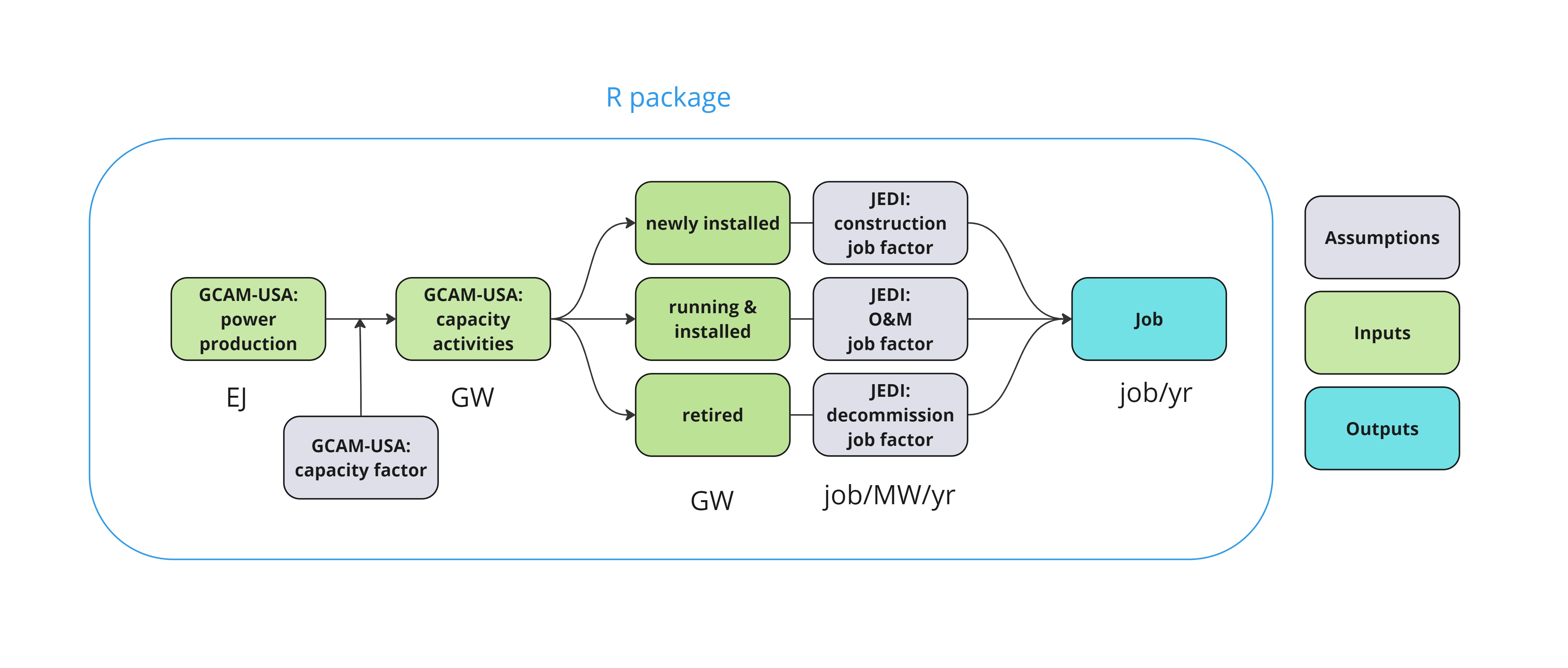
Workflow of GCAMUSAJobs
GCAMUSAJobs utilizes GCAM-USA annual electricity generation outputs to estimate underlying capacity levels based on assumptions about capacity factors and calculate associated power sector jobs based on employment factors. The employment factor represents the average number of jobs created per unit of power plant activity (e.g., jobs per gigawatt). This method is widely used in the relevant literature1,2. GCAMUSAJobs adopts employment factors from NREL’s Jobs & Economic Development Impacts (JEDI) model, which has been broadly used in the literature1,3,4. The tool focuses on estimating direct jobs in the power sector, meaning employment directly involved in the construction, operation, or decommissioning of power plants, as opposed to indirect or induced jobs in the broader economy.
This functionality supports the need for assessing the distributional labor impacts of energy system transition.
Installation Guides
-
Download and install:
- R (https://www.r-project.org/)
- R studio (https://www.rstudio.com/)
Open R studio:
install.packages('devtools')
devtools::install_github('JGCRI/rgcam')
devtools::install_github('JGCRI/GCAMUSAJobs')How-to Guides
See this page for a step-by-step demonstration of how to use the package. In general, this package generates data tables and visualizations related to power generation and job impacts using GCAM-USA model outputs. The workflow proceeds through a series of functions, each building on the output of the previous one. Here are the key processing functions:
| Function | Purpose |
|---|---|
| GCAM_EJ() | Takes GCAM-USA output as input and calculates average annual electricity generation (in exajoules or EJ), broken down by state, fuel type, technology, and activity. |
| GCAM_GW() | Converts the output of GCAM_EJ() into average annual capacity levels (in gigawatts or GW) by state, fuel, technology, and activity (e.g., operation, addition, retirement). Supports both the “Total” and “Net” methods for dealing with simultaneous additions and retirements. |
| GCAM_JOB() | Uses GCAM_GW() results to compute average annual direct job estimates, disaggregated by state, fuel type, and job type (e.g., construction, O&M, decommissioning). Users can select between the “Total” or “Net” methods (default is “Total”). |
Details on Methods can be found here.
Here are the key visualization functions:
| Function | Description |
|---|---|
| PLOT_EF() | Plots annual average employment factors (EFs) during the project period. Assumes 5-year decommissioning periods for all fuels, while construction durations vary across fuels. O&M EFs are shown on an annual basis during the lifetime of a facility. |
| PLOT_GW() | Plots average annual capacity levels by activity and fuel type over years. Uses the output from GCAM_GW(). |
| PLOT_JOB() | Plots average annual direct power sector jobs by fuel and job type over years. Uses GCAM_JOB() output. |
| PLOT_JOB_TYPE() | Plots direct jobs by job type (e.g., construction, O&M) aggregated across all fuels for a selected year. |
| MAP_JOB() | Plots a map of state-level total power sector direct jobs for a selected year. |
Note that all of these PLOT_ functions will produce results either for an individual state or for the U.S. as a whole.
User Notice
GCAMUSAJobs, by default, works with GCAM-USA v7.1, and is compatible with GCAM v6 or later versions conditional on updated GCAM-USA assumption input (e.g., plant retirement assumptions), as this package uses three main inputs: GCAM-USA model outputs, GCAM-USA input data and assumptions, and employment factors from the JEDI model. More details can be found here.
How to Contribute
Contributions to GCAMUSAJobs are welcome. Contributions may include reporting bugs, improving documentation, suggesting new features, adding examples, improving visualization functions, updating employment factor assumptions, or extending the package to work with additional energy-system model outputs. If you identify a bug or have a suggestion, please open an issue on the GitHub repository and include a clear description of the problem or proposed improvement. When relevant, please also include a reproducible example, the version of GCAMUSAJobs you are using, your R version, and any error messages or unexpected outputs.
Code contributions can be submitted through pull requests. Before submitting a pull request, please make sure that the proposed change is clearly documented and that existing package functions continue to work as expected. For larger changes, such as adding new job categories, modifying core assumptions, changing the capacity-accounting method, or supporting new model-output formats, we recommend opening an issue first to discuss the proposed approach. When contributing new data, assumptions, or employment factors, please provide the original data source, describe any processing steps, and document the units, technology categories, job types, and geographic scope. This is especially important because GCAMUSAJobs is designed to support transparent and reproducible employment analysis.
By contributing to this repository, contributors agree that their contributions will be made available under the same license as the package.
_________
- Rutovitz, J., Dominish, E. & Downes, J. Calculating global energy sector jobs: 2015 methodology. (2015).
- Mayfield, E., Jenkins, J., Larson, E. & Greig, C. Labor pathways to achieve net-zero emissions in the United States by mid-century. Energy Policy 177, 113516 (2023).
- Xie, J. J., Martin, M., Rogelj, J. & Staffell, I. Distributional labour challenges and opportunities for decarbonizing the US power system. Nat. Clim. Change 13, 1203–1212 (2023).
- Jacobson, M. Z. et al. 100% Clean and Renewable Wind, Water, and Sunlight All-Sector Energy Roadmaps for 139 Countries of the World. Joule 1, 108–121 (2017).