Scalable Documentation
Scalable is a Python framework for orchestrating multi-step workflows on HPC systems, Kubernetes clusters, and cloud providers with minimal manual overhead. It combines Dask-based task execution, scheduler-aware worker provisioning, optional containerized runtimes, AI assistants, and ML-driven optimization so workloads can run reproducibly across heterogeneous environments.
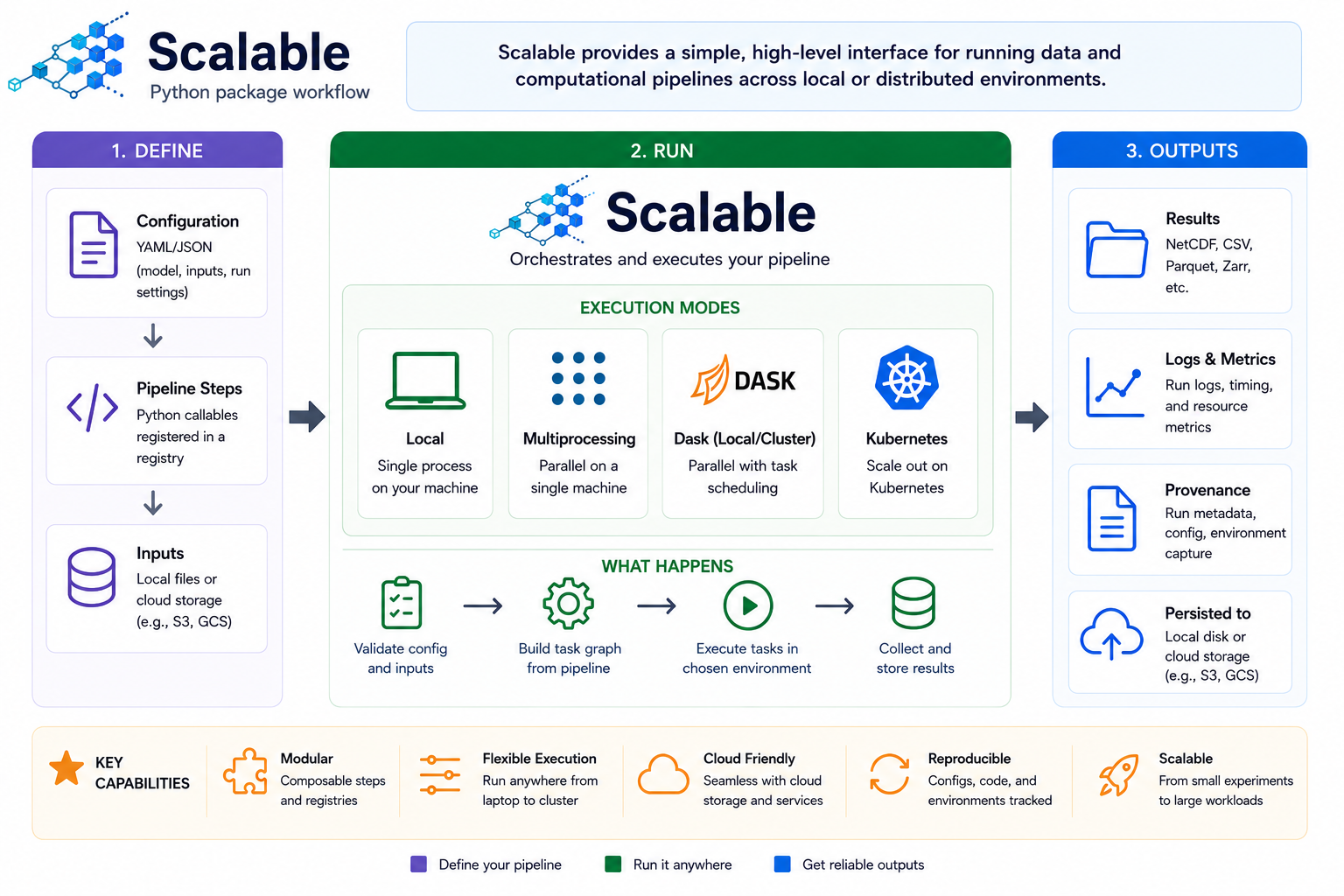
The diagram below shows the high-level architecture.
Scalable is a strong fit when your project needs one or more of the following:
Long-running or resource-intensive workflows on shared HPC infrastructure.
Pipeline-style execution where outputs from one stage feed downstream stages.
Automatic or programmatic scaling of workers and hardware allocations.
Portable execution across local, HPC, Kubernetes, and cloud targets.
AI-assisted model onboarding, failure diagnosis, and workflow composition.
ML-optimized resource prediction and adaptive scaling from run history.
Scalable supports running functions in distinct software environments via container images. A multi-stage Dockerfile can define multiple worker profiles, each with different dependencies, models, or tools, and worker counts can be managed per profile when scaling out a cluster.
Contents
Getting Started
Tutorials